175 old-school recipes · Scaled for 1, 2 or 4
Cut your grocery bill
by up to $3,600 a year
175 old-school meals and lunch-lady kitchen rules from a woman who spent 35 years feeding 400 kids a day — with the cost of every plate worked out and every recipe already scaled for 1, 2 or 4 people.
Groceries went up.
Your household got smaller.
Your cookbook didn't.
- 79 plates under $1 per serving
- $1.15 median priced plate
- 1 · 2 · 4 serving sizes already printed
$47 $27 Today
Instant accessInstant PDF download Print friendly 175 recipes 178 photos
Prefer a real book? See the 462-page printed editionStart with Chapter 4 — 25 one-pot meals for one or two.
See what's inside
- 358 Ebook pages
- 175 Recipes
- $1.15 Median plate
- 1 · 2 · 4 Serving sizes
- 178 Photos
The problem, plainly
Your grocery bill changed.
The way most cookbooks are written didn't.
Food prices climbed.
Meanwhile, millions of people who once cooked for four are now cooking for one or two — while recipes still tell them to buy family-size quantities.
Doris' book starts with the number most cookbooks leave out:
What does this plate actually cost?
- $0.40 per serving Bean Soup, Senate Style
- $0.49 per serving Chicken Noodle Soup From a Carcass
- $1.43 per serving One-Pan Chicken Legs With Rice
- $1.66 per serving Hamburger Gravy Over Mashed Potatoes
Four of the 189 priced plates in the book. Costs are calculated from a dated ingredient price list that is printed inside.
- 79 plates under $1 per serving
- 185 of 189 priced plates under $2
- $1.15 median plate, across the book
79 plates under a dollar.
The whole 358-page ebook is $27.
Where the number comes from
What does "up to $3,600" actually mean?
We did the arithmetic — and deliberately used the smaller number.
| Household | Moderate | Thrifty | Potential yearly difference |
|---|---|---|---|
| Woman, 51–70 | $396/mo | $282/mo | $1,368 |
| Man, 51–70 | $449/mo | $336/mo | $1,361 |
| Couple, both 51–70 | $775/mo | $566/mo | $2,501 |
| Family of four | $1,387/mo | $1,018/mo | $4,422 |
The $3,600 headline applies to a family of four. A single person or a couple should read their own row — the potential difference there is smaller.
"Why does the cover say $3,600 when the comparison reaches $4,422?"
Because we would rather make the smaller claim than the bigger one.
We could have put
$4,422
on the cover.
We didn't.
The USDA comparison reached the larger figure. The book deliberately uses the more conservative claim of up to $3,600.
The comparison uses USDA May 2026 Food Plan figures. Actual savings depend on current spending, location, shopping habits and how much food the household already cooks at home. This book is not a USDA product and is not endorsed by the USDA — government price data is used as reference material, nothing more.
This book does not promise $3,600.
It shows you the methods and the math.
What you actually get
175 recipes.
Not one of them makes you do the serving-size math.
Hamburger Gravy Over Mashed Potatoes
$1.66 per serving
$6.64 full batch of 4
your local price
| Ingredient | For 1 | For 2 | For 4 |
|---|---|---|---|
| Ground beef, 80/20 | ¼ lb | ½ lb | 1 lb |
| All-purpose flour | 1 Tbsp | 2 Tbsp | ¼ cup |
| Whole milk | ½ cup | 1 cup | 2 cups |
| Russet potatoes | 1 medium | 2 medium | 4 medium |
| Butter | 1 tsp | 2 tsp | 4 tsp |
| Salt & black pepper | to taste | to taste | to taste |
- Peel and boil the potatoes until a fork goes through easily.
- Brown the beef in a dry skillet. Don't drain all of the fat — that is your gravy.
- Stir the flour into the beef and fat. Cook one minute.
- Pour in the milk a little at a time, stirring, until it thickens.
- Mash the potatoes with the butter. Season both, then spoon the gravy over.
Doris' note: A pound of beef is plenty for four when there is gravy and potato under it. In the school kitchen we stretched the meat, never the plate.
Leftovers: gravy keeps 3 days covered; thin it with a splash of milk and serve over toast.
160°F — cook ground beef through.
Every recipe page shows:
- Cost per serving
- Cost of the full batch
- Your own local-price blank
- Ingredients for ONE
- Ingredients for TWO
- Ingredients for FOUR
- 4–6 simple steps
- Doris' kitchen note
- What to do with the leftovers
- Food-safety temperature where needed
1 · 2 · 4 Every one of the 175 recipes prints all three serving sizes. No halving, no doubling, no guessing.
Average cost per plate, by chapter
- Breakfasts $0.62
- Desserts $0.38
- Soups $1.03
- Sandwiches $1.15
- One-pot for 1 or 2 $1.17
- Dinners $1.30
- Ground beef $1.64
Cheapest plate in the book: $0.16. Most expensive: $2.45. Median: $1.15.
Inside the book
- 01 The Lunch Lady Rules
- 02 Poor Man Dinners
- 03 1950s Breakfasts for Pennies
- 04 One-Pot Meals for One or Two
- 05 Ground Beef 25 Ways
- 06 Sandwiches & Lunch Counter Classics
- 07 Soups, Stews & Depression-Era Stretchers
- 08 Cafeteria Classics From Scratch
- 09 Cheap Desserts & 1970s Snacks
- 10 The Weekly Pantry
- 11 The Leftovers Playbook
- ★ Bonus Printables
- A–Z Index
- One recipe per page
- Large print
- Wide margins
- Print friendly
The ebook was set to be read comfortably in a kitchen, not squinted at: 15pt body type, high contrast, generous margins, and US Letter 8.5 × 11 PDF pages so a recipe prints on one sheet.
One book Two ways to own it
Choose your edition
Same Lunch Lady method. Choose how you want to use it.
175 old-school recipesScaled for 1–2–479 plates under $1
-
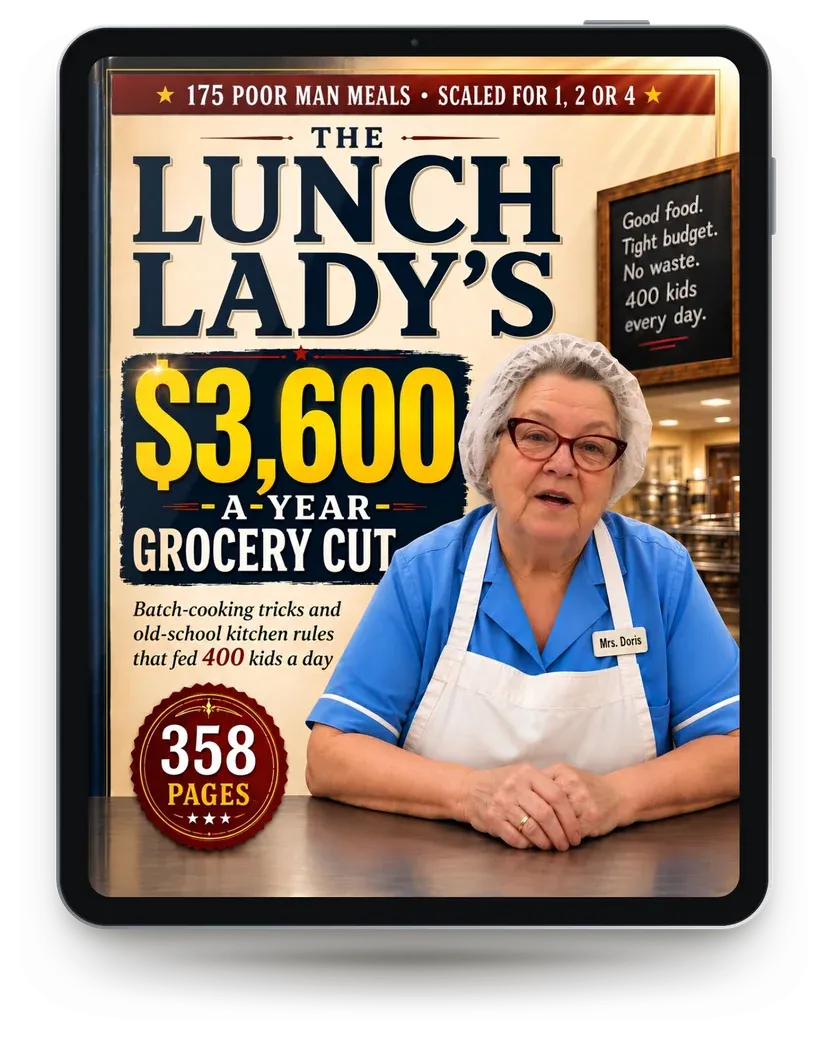
Instant Digital Edition
Want it instantly?
Download it today. Cook from it tonight.
$27 was $47
Launch price One payment
- Instant PDF download — all 358 pages
- Read on your phone, tablet or computer
- Print the pages you use most at home
- 7-Day Money-Back Guarantee
Get the instant book — $27Instant access Secure checkout
-
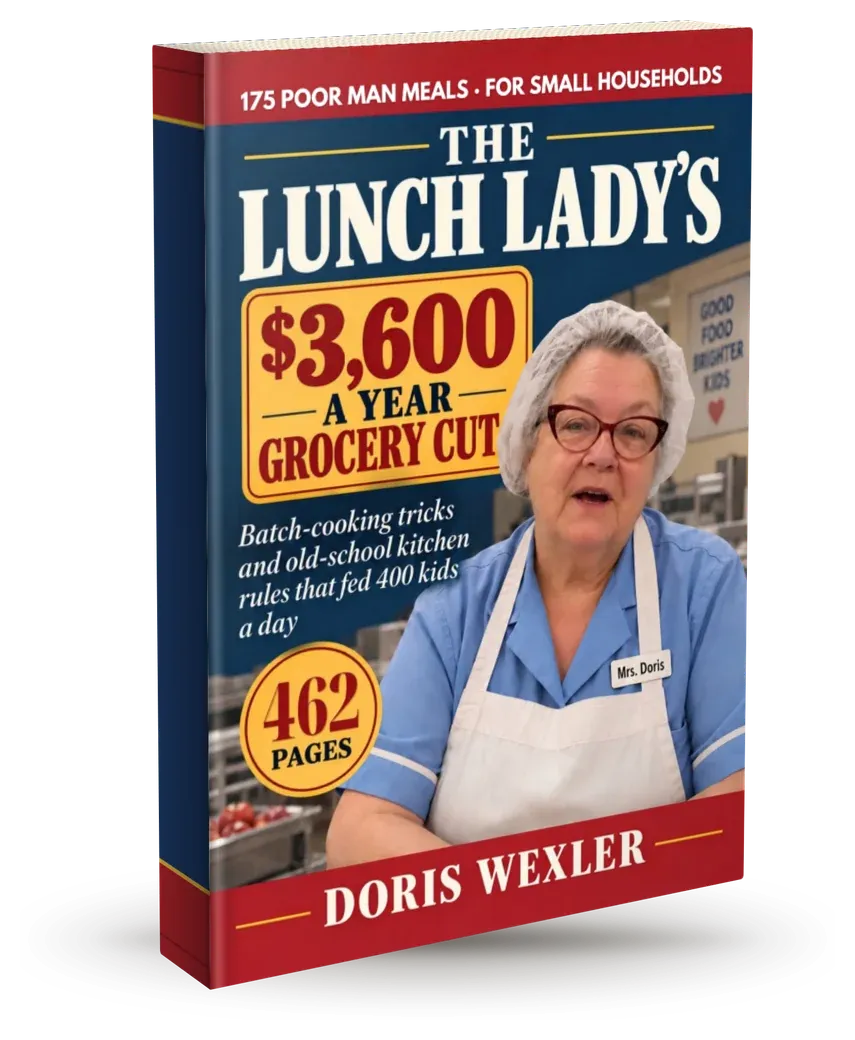
Printed Edition
Prefer a real book in your kitchen?
A 462-page copy, delivered to your door.
$57
Free U.S. shipping included
- 462-page printed book — a real copy
- Keeps open beside you on the kitchen counter
- Printed and shipped to your door
- Tracked delivery
Order the printed book — $57Free U.S. shipping Tracked delivery
Ordering a paper copy? Read the Printed Book Shipping & Returns
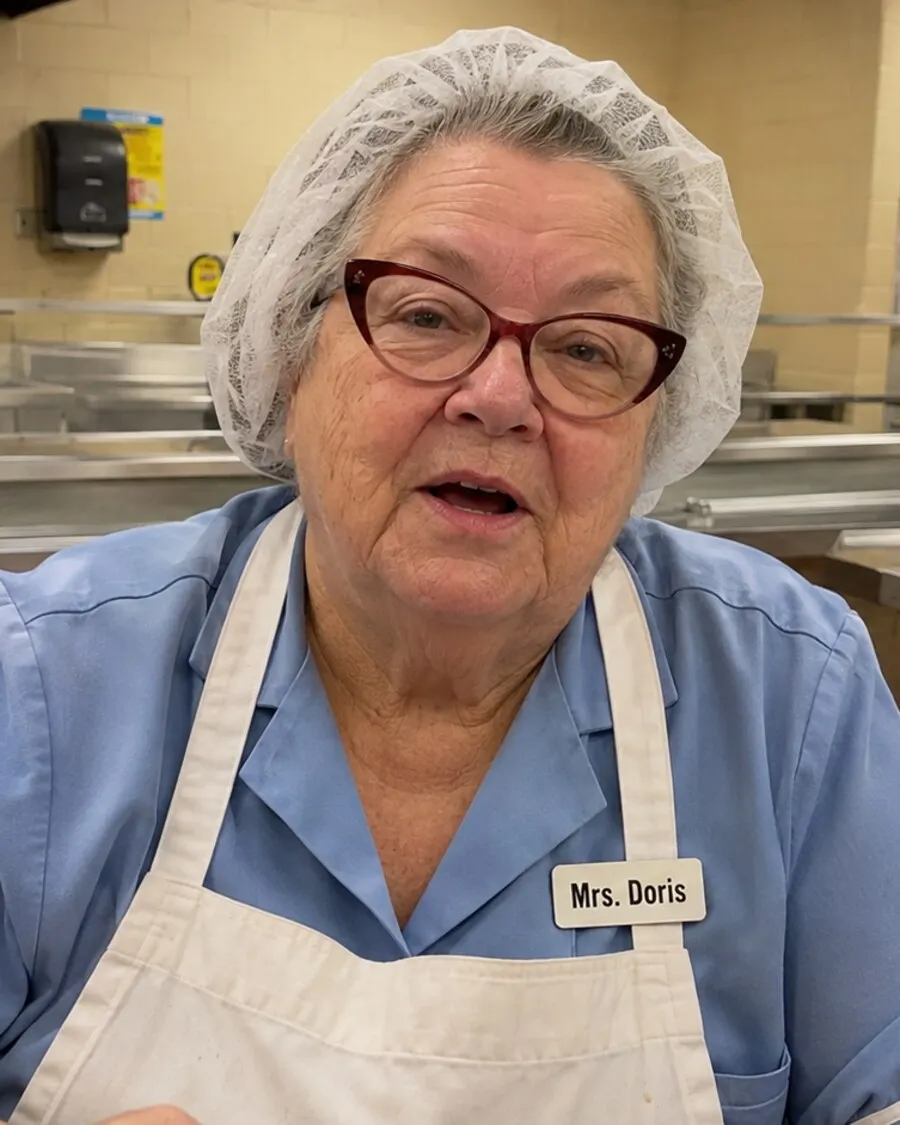
Who wrote this
"I fed 400 kids a day. You learn pretty fast where the money disappears."
I cooked in a public school kitchen from 1978 to 2013. Thirty-five years, and about four hundred children a day.
You don't get a bigger budget in a school kitchen. You get the same money and the same number of mouths, every single day. So you cook in batches. You stretch the expensive things and let the cheap things do the filling. You throw almost nothing away. And you find out quickly that plain, familiar food is what people actually eat.
That is all this book is: the way we cooked, written down for a household of one, two or four — with what every plate costs printed right there on the page.
Why these numbers are different
- Ingredient prices are sourced and dated.
- Price assumptions can be checked.
- The book prints the price list.
- Readers can write their own local price on every recipe.
- Food-safety temperatures appear directly on applicable recipes.
- The book does not hide exceptions to its own pricing rules.
Why people grab it:
- They cook for one or two now
- They want to know what dinner actually costs
- They want familiar food, not trendy recipes
- They want fewer leftovers and less waste
Questions
Before you choose your edition, here's what people usually want to know.
About the book
I only cook for myself. Is this really for me?
Yes. Chapter 4 contains 25 recipes written specifically for one or two people, and every one of the 175 recipes in the book has a one-serving column.
What if I cook for two?
Every recipe prints quantities for one, two and four people, side by side. There is no dividing a family recipe in your head at the stove.
Does cheap food mean bad food?
The savings come from four ordinary kitchen habits: choosing less expensive ingredients, cooking in batches, stretching the costly items across more plates, and using up what is left over instead of throwing it out. It is plain, familiar American food — the sort a school kitchen served. This book makes no nutrition or health claims of any kind.
Are these just old prices?
No. The cost calculations use dated price data, and the price list itself is printed inside the book so you can see exactly what every figure was based on. Every recipe also leaves room to write in your own local price.
I'm not a confident cook. Is this complicated?
Most recipes use ordinary cookware — a skillet, a pot, a sheet pan — and four to six steps. Food-safety temperatures are printed on the recipes that need them.
What exactly do I receive with the Digital Edition?
A 358-page PDF containing 175 recipes, 178 photographs, weekly plans, shopping lists, leftovers charts, emergency menus, printable trackers and the complete index — delivered as an instant download.
Can I print pages from the Digital Edition?
Yes. The PDF pages are US Letter 8.5 × 11 inches and set to be print-friendly — one recipe per page, high contrast, wide margins.
Editions, shipping & returns
What's the difference between the Digital and Printed Editions?
The Digital Edition is an instant PDF download you can read on your phone, tablet or computer and print pages from at home.
The Printed Edition is a 462-page physical book that is printed and shipped directly to you.
Both are designed around Doris' practical Lunch Lady approach — the main difference is how you prefer to use the book.
How do I receive the Digital Edition?
Immediately after purchase, you'll receive access to download your PDF. You can save it to your phone, tablet or computer and print individual pages whenever you like.
Do I receive a physical book when I buy the $27 Digital Edition?
No. The $27 edition is an instant digital PDF download.
If you'd prefer a real book delivered to your home, choose the 462-page Printed Edition for $57.
How much is the Printed Edition?
The 462-page Printed Edition is $57 and includes free U.S. shipping.
Is shipping really free?
Yes. Standard shipping within the United States is included in the $57 price.
If ordering from outside the United States and international checkout is available, additional shipping charges may apply and will be shown at checkout.
Can I return the Printed Edition if I change my mind?
Each printed copy is produced specifically for an order, so we do not generally accept returns simply because a customer changes their mind.
However, if your book arrives damaged, defective or incorrectly printed, please contact us and we'll help make it right.
What if my printed book arrives damaged?
Please contact us with your order details and clear photos of the damage or printing problem. We'll review the issue and work with our printing partner to arrange an appropriate replacement or resolution.
What if my package doesn't arrive?
Printed-book shipments use tracked delivery. If your tracking indicates that the package may be lost, contact us and we'll investigate the shipment with our fulfillment partner/carrier.
What if I entered the wrong shipping address?
Please double-check your shipping address before completing your order.
If an order has already entered production or is returned because an incorrect address was supplied or the parcel was not collected, additional shipping charges may be required to send it again.
Does the 7-Day Money-Back Guarantee apply to the printed book?
The 7-Day Money-Back Guarantee applies to the Digital Edition.
Printed-book issues involving damage, defects or delivery problems are handled separately through our printed-order support policy.
Full details for paper copies: Printed Book Shipping & Returns
Two ways to own it
How would you like your copy?
Get it instantly today, or have the printed edition delivered to your door.
-
Digital
Instant Ebook
$27
358-page PDF Instant download
Get the ebook7-Day Money-Back Guarantee
-
Printed
462-Page Printed Book
$57
Free U.S. shipping Tracked delivery
Order the printed book
Tonight's dinner doesn't need
to cost what you think it does.
175 old-school recipes.
79 plates under $1.
Every recipe scaled for one, two or four.
$47 $27 Today
Get the instant book — $27358-page ebook Instant PDF download Print friendly
Prefer the printed edition?Savings figures are potential, not a promise. What a household actually keeps depends on what it spends now, where it shops and what it already cooks at home. Figures are drawn from USDA Food Plans data for May 2026 and Bureau of Labor Statistics average prices for July 2026. This book is not affiliated with or endorsed by the USDA. Nothing in it is nutrition or medical advice. The $27 Digital Edition is delivered as an instant PDF download; the 462-page Printed Edition ($57, free U.S. shipping) is printed and shipped separately.
Printed Edition
Printed book shipping & order support
- Shipping
- The Printed Edition includes free standard shipping within the United States. Tracking information is provided when available after the order ships.
- Damaged or Defective Books
- If your copy arrives damaged, defective or incorrectly printed, contact us with your order details and photos of the issue. We'll work with our printing partner to arrange an appropriate replacement or resolution.
- Lost Shipments
- If a tracked shipment appears to be lost, contact us so we can investigate the delivery with our fulfillment partner or carrier.
- Incorrect Addresses / Unclaimed Packages
- Customers are responsible for entering a complete and accurate delivery address. If an order needs to be shipped again because an incorrect address was supplied or a package was not collected, additional shipping charges may apply.
- Change-of-Mind Returns
- Printed copies are made specifically for each order, so we generally do not accept change-of-mind returns. For damaged, defective or delivery-related issues, please contact us and we will help resolve the problem.
Need help with a printed order? See how to contact us.
Contact
Questions about your copy of The Lunch Lady's $3,600-a-Year Grocery Cut — a download link, a printed order, or a refund? We are glad to help.
Digital Edition customers
The fastest way to reach us is to reply to the receipt email you received from Gumroad after your purchase. You can also message the seller from your Gumroad library.
Printed Edition customers
Reply to the order confirmation email you received from Payhip and include your order details — plus clear photos if your book arrived damaged or misprinted. See Printed Book Shipping & Returns for how printed orders are handled.
Before you buy
Most questions are answered in the questions section above.